

Chinese Character: A Beginner’s Complete Guide to Hanzi in 2026


Chinese characters are more than just symbols on a page — they are a unique blend of art, history, and meaning. Each character tells a story, reflects ancient wisdom, and opens a door to Chinese culture. If you’ve ever felt curious by Chinese characters, don’t worry — you’re not alone.
In this beginner-friendly guide, you’ll discover what Chinese characters (Hanzi) are, why learning them matters, the most common characters to start with, and practical tools and strategies to help you read, write, and recognize them.
Part1: What Are Chinese Character (Hanzi)?
Chinese characters, also known as Hanzi (汉字), are the written symbols used in Chinese. Unlike alphabetic systems, each character represents a meaningful unit, often tied to a syllable.
Learn authentic Chinese from those who live and breathe the culture.
Specially tailored for kids aged 3-18 around the world!
Get started free!1、Origins of Chinese Character
Chinese characters have a history of over 3,000 years, evolving through several stages:
- Oracle Bone Script (甲骨文) – earliest known form, carved on bones and shells
- Bronze Script (金文) – used on ritual vessels
- Seal Script (篆书) – standardized during the Qin Dynasty
- Clerical & Regular Script (隶书 / 楷书) – foundations of modern writing
Despite visual changes, many core ideas remain consistent.

2、Types of Chinese Character
Most Chinese characters fall into these categories:
| Type | Description | Example |
|---|---|---|
| Pictographs | Visual representations | 日 (sun), 月 (moon) |
| Ideographs | Abstract ideas | 上 (up), 下 (down) |
| Compound Ideographs | Combined meanings | 休 (person + tree = rest) |
| Phono-semantic Compounds | Sound + meaning (over 80%) | 妈 (mother) |
Understanding these types makes learning Chinese characters much easier.
3、Simplified vs. Traditional Chinese Character
Before diving deeper, it’s important to know the difference:
- Simplified Chinese Characters: Used in Mainland China, Singapore
- Traditional Chinese Characters: Used in Taiwan, Hong Kong, Macau
| Example | Simplified | Traditional |
|---|---|---|
| Dragon | 龙 | 龍 |
| Learn | 学 | 學 |
If you’re a beginner, starting with simplified Chinese characters is often recommended — but both systems share the same roots.
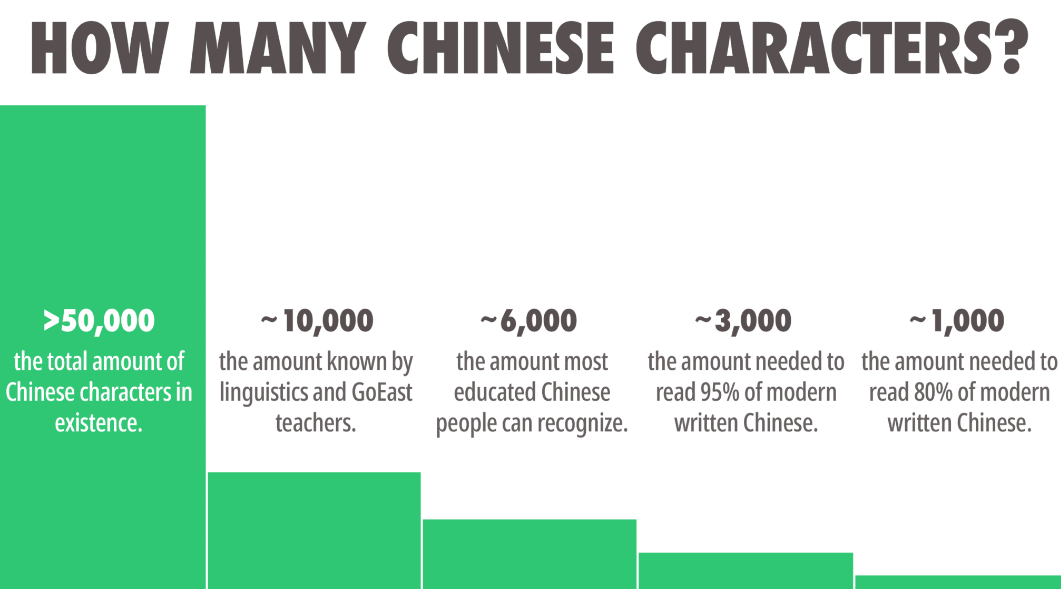
4、How Many Chinese Characters?
The total number of existing characters is vast, with estimates ranging from tens of thousands to over 100,000. However, the official list in common usage includes about 3,000 to 5,000 characters, which are sufficient for reading newspapers, literature, and everyday communication.
The “汉语大字典” (Chinese dictionary), a comprehensive dictionary, contains over 50,000 characters in Chinese, including many rare and historical ones.
Learn more about: How Many Characters Are in the Chinese Alphabet?
Part2: Why Learn Chinese Character?
1、Cultural Identity and Roots
If you grew up hearing Chinese at home, learning Chinese characters is the key to deepening your cultural roots: it lets you connect with your family history, read Chinese names, signs and cultural texts with ease, and build solid literacy skills that go beyond just speaking the language.
2、Chinese Culture Learning
Chinese characters unlocks a more profound understanding of the language and its culture: it enables you to grasp the meaning of words independently without relying on pinyin, recognize inherent patterns across different words for more efficient learning, and gain a genuine appreciation for Chinese art, calligraphy and traditional philosophy through direct engagement with the written form.
3、Future Opportunities
As one of the most widely used written languages globally, Chinese character is a valuable asset for lifelong growth: it lays a solid foundation for academic success, opens up diverse international career opportunities, and facilitates smooth cross-cultural communication.
Before learning Chinese characters, one can first understand how many words are required for different goals, which can better help in setting psychological expectations.
| Learning Goal Type | Learning Objective | Required Characters | Required Vocabulary | Corresponding Exam/Test |
|---|---|---|---|---|
| Basic Communication | Simple daily conversations, e.g., greetings, ordering food, shopping | 300–500 characters | 500–800 words | HSK 1 |
| Beginner Reading | Children’s books, graded readers, simple texts | 500–1,000 characters | 1,000–1,500 words | HSK 2–3 |
| Daily Work/Study | Office communication, emails, classroom learning | 1,500–2,000 characters | 2,000–3,000 words | HSK 4 |
| Advanced Reading | Newspapers, novels, academic texts | 3,000–4,000 characters | 5,000–8,000 words | HSK 5 |
| Near-Native Reading | Literature, classical texts, professional materials | 5,000+ characters | 10,000+ words | HSK 6 |
The Hanyu Shuiping Kaoshi (HSK) is China’s official proficiency test for non-native Chinese speakers.It provides formal certification of one’s language abilities, simultaneously unlocking new opportunities in academics, career, and cultural understanding.
To understand HSK, refer to the article HSK Levels 2026: A Complete Guide to Old(1-6) vs New HSK(1-9).
Part3: Common Chinese Characters for Beginner
Starting with high-frequency characters builds confidence fast.
Learning Chinese seems hard when you look at thousands of characters, but did you know that just 100 basic Chinese characters already cover nearly half of all daily written Chinese? That’s right, almost 50% of picture books, simple signs, and even text messages!
Top 15 Common Chinese Characters
| Character | Pinyin | Meaning |
|---|---|---|
| 人 | rén | person |
| 口 | kǒu | mouth |
| 日 | rì | sun/day |
| 月 | yuè | moon/month |
| 水 | shuǐ | water |
| 火 | huǒ | fire |
| 山 | shān | mountain |
| 大 | dà | big |
| 小 | xiǎo | small |
| 中 | zhōng | middle |
| 学 | xué | learn |
| 我 | wǒ | I / me |
| 你 | nǐ | you |
| 好 | hǎo | good |
| 有 | yǒu | have |
These 15 common Chinese characters appear in hundreds of words, making them perfect for beginners.
Learn all 100 basic and common chinese character:100 Basic Chinese Characters Every Kid Should Learn (with Pinyin)

Part4: How to Learn Chinese Character Effectively
Learning Chinese characters involves three key skills: recognizing, reading, and writing.
Recognition means knowing the character and its parts. Reading links the character to its sound and meaning in sentences. Writing helps you remember characters and their structure.
Mastering recognition, reading, and writing makes learning Chinese characters easier and more effective.
1. Learn to Recognize Chinese Character
Recognition comes first.
Chinese character recognition involves understanding that each character consists of a defined set of strokes and radicals.Learning these radicals and practicing correct stroke order is the most important process to recognize chinese character.
This article provides a detailed introduction to how to identify Chinese characters:How to Recognize Chinese Characters: Learn and Master Online
This two articles helps you learn chinese radicals:A Vital Guide for Beginners with 50 High-frequency Chinese Radicals 、List of 214 Basic Chinese Radicals and Meanings [Free PDF]
2. Learn to Read Chinese Character
“Reading Chinese characters requires first understanding their structure and pronunciation rules. Then, through extensive exposure to children’s books, graded reading materials, and other contexts, vocabulary is reinforced in meaningful situations. Ultimately, gradually develop fluent reading skills.
This two articles provides a detailed guide on how to learn to read Chinese characters and introduces children’s reading materials suitable for learning character:Exploring Chinese Characters: Reading & Writing Made Easy 、40 Chinese Books Every Child Should Grow Up With (Ages 4–15+)
3. Learn to Write Chinese Character
To learn how to write Chinese characters, you first need to understand their basic structure and stroke order, as each character is composed of specific strokes arranged in a particular pattern.
When learning, you can start by identifying common components and radicals, breaking characters down to understand their meaning and structure, and then practicing according to Chinese stroke order rules (such as top to bottom, left to right).
This article also provides many practical tools to help you learn how to write Chinese characters:Learn to Write Chinese Characters: Beginner’s Guide in 2026
4、Best Tools & Websites to Learn Chinese Character
- Character Dictionary Tools – 101dict Character Dictionary、HanziCraft
- Flashcard Apps – Wukong App、HSK Flashcard
- Beginner Chinese Learning Websites – Wukong Chinese 、Hanzi Guide
When choosing a tool, look for:
- Stroke order animations
- Simplified & traditional options
- Contextual examples
Final Thoughts
Learning Chinese characters may seem challenging, but when you successfully learn a bit, you can find it’s also deeply rewarding. By understanding their structure, practicing stroke order, and using the right tools, you’ll build confidence faster than you expect.
Remember: every fluent reader started with one character.Try writing your first Chinese character today — and share your progress!You want to learn more about Chinese character resources, including free PDF resources,you can’t miss Wukong Education resourses.
FAQS
What does this symbol mean in 愛 (ài)?
In the character 愛 (ài), the symbol represents “heart” (心) in the middle. The character as a whole means “love”, combining the ideas of “heart,” “action,” and “affection.” Understanding these components helps learners remember the meaning and structure.
How do you say 1, 2, 3, 4, 5, 6, 7, 8 in Chinese?
Numbers 1 to 8 are pronounced as:
1 – 一 (yī)
2 – 二 (èr)
3 – 三 (sān)
4 – 四 (sì)
5 – 五 (wǔ)
6 – 六 (liù)
7 – 七 (qī)
8 – 八 (bā)
What does xiǎng (想) mean?
The character 想 (xiǎng) generally means “to think”, “to want”, or “to miss” depending on context. It combines the radical for “heart” (心) with the component 相, symbolizing thought and feeling together.
What are basic Chinese characters?
Basic Chinese characters are the most frequently used characters that form the foundation of reading and writing. For beginners, these typically include characters for people, numbers, days, common objects, and simple verbs, roughly 300–500 characters for daily communication. Learning these first helps you quickly recognize, read, and write simple sentences.
Learn authentic Chinese from those who live and breathe the culture.
Specially tailored for kids aged 3-18 around the world!
Get started free!
A distinguished scholar with a Master’s in Chinese Philology, Meng Yuan brings over 8 years of global expertise to Wukong Education. As a Senior Curriculum Architect, she has spent 6 years on the front lines of international classrooms, followed by 2 years spearheading pedagogical research. Meng Yuan specializes in the cognitive development of Pinyin and Hanzi acquisition and has successfully guided hundreds of students through competitive Chinese entrance exams. At Wukong Chinese, she leads the original content initiative, ensuring every lesson aligns with the highest international teaching standards.


![Top 15 Summer Programs for High School Students [2025]](https://wp-more.wukongedu.net/blog/wp-content/uploads/2024/06/image-104-1-520x293.png "Top 15 Summer Programs for High School Students [2025]")


Comments0
Comments